 Rapidontics Labs
Digital impression checklist for crown and bridge cases
Reviewed by Dr. Utkarsh Rathore, BDS · UP State Dental Council Reg. 21803 · 23 Nov 2026
A digital impression is a clinically acceptable choice for crowns and short bridges, and a review found its accuracy at the same level as conventional methods [1]. What decides the result is mostly the finish line: whether it is exposed, dry and fully captured before the case goes to the lab.
This checklist is built from published studies. Most are in vitro, so treat them as guidance, not proof for every clinical situation.
When digital scanning suits the case
For crowns and short fixed dental prostheses (FDPs), a systematic review found digital impression accuracy at the same level as conventional impressions [1]. The same review found digital techniques faster and able to shorten operation time [1].
The picture changes for full-arch work. That review still recommended conventional impressions for full-arch impressions [1]. Decide the impression route first, then work through the margin checks below.
Check 1: Is the finish line exposed?
This is the biggest risk on a crown case. In one in vitro study, subgingival finish lines were not accurately captured by the two intraoral scanners tested [2]. Subgingival groups showed greater vertical and horizontal discrepancies than equigingival groups, even though a single-cord technique was used [2].
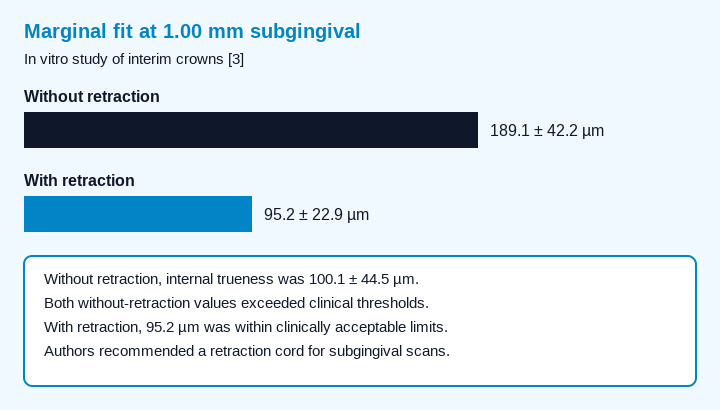
Another in vitro study scanned interim crown preparations with finish lines from 0 to 1.00 mm subgingival [3]. Without gingival retraction, internal trueness and crown fit got worse as the finish line went deeper [3]. At 1.00 mm without retraction:
- internal trueness was 100.1 ± 44.5 µm
- marginal fit was 189.1 ± 42.2 µm
- both exceeded clinical thresholds [3]
With retraction, trueness and fit stayed stable at all depths [3]. At 1.0 mm, marginal fit was 95.2 ± 22.9 µm, within clinically acceptable limits [3]. The authors recommended gingival displacement with a retraction cord when scanning subgingival preparations [3].
Check 2: Which retraction method was used?
The method matters a little. A study of three scanners (i700, TRIOS 5 and Aoralscan3) compared no cord, cords of different colour and diameter, and Teflon tape on an equigingival preparation [4]. Cord colour, cord diameter and tape all affected scanning accuracy, and the effect differed between scanners [4].
The same study judged the measured discrepancies not clinically relevant [4]. So the point is not that one cord is essential. It is that the retraction method and the scanner both influence the scan, and the lab is better placed to help if it knows what was used [4].
Check 3: Is the field dry?
Saliva contamination significantly increased vertical and horizontal discrepancies at every finish line location in an in vitro study [2]. The increase was greater for subgingival finish lines [2].
Before you submit, look at the margin on screen. If it sits in a wet or bloody area, consider whether a rescan is needed.
Check 4: Is the scan itself complete?
The studies above measured trueness and precision at the preparation and margin areas separately [4]. The margin can be less accurate than the rest of the preparation, so check it on its own.
Before you send the case:
- View the full margin all the way round, not just the occlusal surface.
- Check that no area is missing or distorted at the finish line.
- Rescan any area you cannot read clearly.
Check 5: Is this an implant or long-span case?
For implant-supported crowns and short FDPs, one review found digital impression systems gave clinically acceptable fit [1].
Complete-arch implant work is less settled. A 2026 meta-analysis of 37 studies found no significant overall difference between digital and conventional impressions [5]. Conventional methods were slightly favoured in cases with more than 4 implants, and photogrammetry appeared to reduce that effect [5]. The authors noted a lack of consensus and a need for better in vivo studies [5].
A separate meta-analysis found photogrammetry more accurate than intraoral scanning in complete-arch implant impressions [6]. Intraoral scanning showed angular deviation above the 1° threshold needed for passive fit [6]. It still recommended a rigid prototype try-in until further clinical trials are available [6].
If your case is a full-arch implant bridge, tell the lab so, and plan a verification step.
What to put in the case notes
The evidence above suggests that the lab benefits from knowing the following:
- the scanner used [4]
- the retraction method [4]
- the finish line position, equigingival or subgingival [3][2]
- whether the case is a single crown, a short bridge, or a full-arch or implant case [1][5]
Rapidontics Labs takes digital cases, and the same points apply to any lab you work with.
Practical checklist before you submit
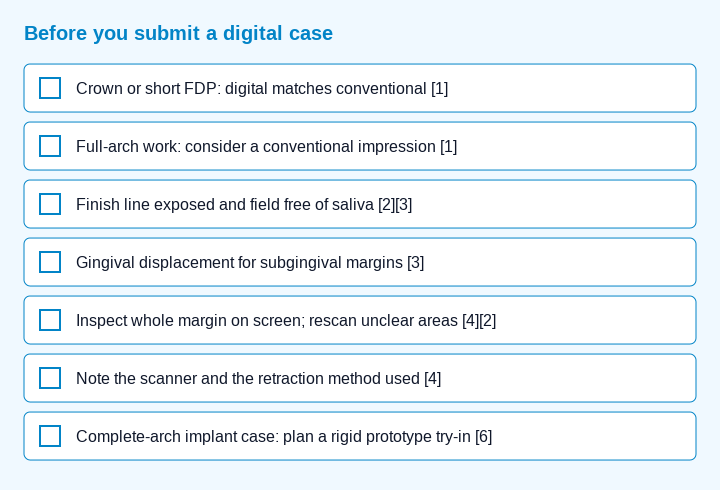
- [ ] Confirm the case is a crown or short FDP, where digital accuracy matches conventional [1].
- [ ] For full-arch work, consider whether a conventional impression is more suitable [1].
- [ ] Confirm the finish line is exposed, especially if subgingival [3][2].
- [ ] Use gingival displacement for subgingival margins [3].
- [ ] Note the retraction method used [4].
- [ ] Check the field is free of saliva before scanning the margin [2].
- [ ] Inspect the whole margin on screen and rescan unclear areas [4][2].
- [ ] Record the scanner used [4].
- [ ] For complete-arch implant cases, plan a rigid prototype try-in [6].
- [ ] Flag implant number, since results may differ above 4 implants [5].
Frequently asked questions
Are digital impressions accurate enough for crowns and bridges?
A systematic review found digital impression accuracy at the same level as conventional methods for crowns and short fixed dental prostheses [1]. For full-arch impressions, the same review still recommended conventional methods [1].
Does retraction matter for a digital impression?
In one in vitro study, scans without retraction lost accuracy as the finish line got deeper, with marginal fit of 189.1 µm at 1.00 mm. With retraction, fit stayed stable [3]. The authors recommended a retraction cord for subgingival preparations [3].
Does the type of cord change the scan?
Cord colour and diameter, and Teflon tape, affected accuracy on the three scanners tested, but the measured discrepancies were not clinically relevant [4].
Does saliva affect intraoral scanning of a finish line?
Yes. In an in vitro study, saliva significantly increased vertical and horizontal discrepancies, and the effect was greater for subgingival finish lines [2].
Can I use intraoral scanning for a full-arch implant bridge?
The evidence is mixed. One meta-analysis found no significant overall difference from conventional impressions, with conventional methods slightly favoured above 4 implants [5]. Another found photogrammetry more accurate than intraoral scanning and still recommended a rigid prototype try-in [6].
Sources
- Digital Versus Conventional Impressions in Fixed Prosthodontics: A Review.. Journal of prosthodontics : official journal of the American College of Prosthodontists, 2018. https://doi.org/10.1111/jopr.12527
- Effect of finish line location and saliva contamination on the accuracy of crown finish line scanning.. Journal of prosthodontics : official journal of the American College of Prosthodontists, 2024. https://doi.org/10.1111/jopr.13658
- Does Intraoral Scanning at the Subgingival Finish Line Affect the Accuracy of Interim Crowns?. Journal of functional biomaterials, 2025. https://doi.org/10.11607/ijp.5079
- Influence of Color and Diameter of Retraction Cords and Teflon Tape on the Accuracy of Tooth Preparations Digitized by Using Intraoral Scanners.. Journal of esthetic and restorative dentistry : official publication of the American Academy of Esthetic Dentistry ... [et al.], 2026. https://doi.org/10.1111/jerd.70054
- Comparative analyses of accuracy between digital and conventional impressions for complete-arch implant-supported fixed dental prostheses-A systematic review and meta-analysis.. Journal of prosthodontics : official journal of the American College of Prosthodontists, 2026. https://doi.org/10.1111/jopr.14094
- Photogrammetry Versus Intraoral Scanning in Complete-Arch Digital Implant Impression: A Systematic Review and Meta-Analysis.. Clinical implant dentistry and related research, 2025. https://doi.org/10.1111/cid.70059
This article was drafted with AI assistance from the sources listed above and reviewed by Dr. Utkarsh Rathore on 23 Nov 2026. It describes laboratory and digital workflows; clinical decisions stay with the treating dentist.